Live situation report

A clear view of reported plague cases worldwide.

Officially confirmed and clearly labeled unverified reporting, mapped without speculation. Informational only—not medical advice.

Confirmed deaths0
Confirmed cases0
Unverified reports1

Reviewed Oct. 5, 2026 · No officially confirmed cases currently tracked · One suspected report covered by The Washington Post, NBC News, CNBC, and Axios

Global overview

Case map

Confirmed Unverified
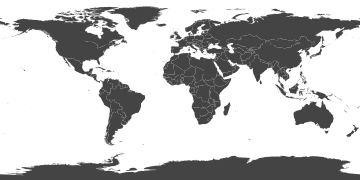
World map showing reported plague locations
Suspected · not confirmed

Irkutsk region

Russia

A 28-year-old employee of the Irkutsk Anti-Plague Research Institute died after developing severe pneumonia. Russia’s public-health agency described the illness as pneumonia of unknown cause and said testing found no pathogen connected to her work. Reports say 189 people were placed under medical observation; officials said monitored contacts had tested negative and showed no symptoms. U.S. agencies are seeking more information.

Source: Washington Post ↗Updated Oct. 5, 2026

Tap a marker for details · Locations are approximate

Source desk

Latest updates

Last updated Oct. 5, 2026
01

U.S. officials seek details on reported Russian plague death and quarantines

U.S. health and national-security agencies are seeking more information about the worker’s death and quarantines at Siberian hospitals. Officials cautioned that the diagnosis remains unconfirmed and described the current risk to the United States as low unless an infected person travels.

Authority reference: WHO disease context ↗
02

Lab worker dies as nearly 200 contacts are monitored

NBC News reports on the suspected case involving an employee of an anti-plague research institute and the precautionary monitoring of nearly 200 people. Russian authorities have not confirmed plague as the cause of death.

Authority reference: CDC plague guidance ↗
03

Nearly 200 monitored after researcher’s death

CNBC reports that 189 people in the Irkutsk region were placed under medical observation over suspected exposure. The reported plague link remains unconfirmed by Russia’s federal public-health agency.

Authority reference: WHO disease context ↗
04

White House monitors suspected plague case in Russia

An administration official said the White House was aware of the reports, monitoring the situation, and assessing options. Axios notes that Russian health authorities took precautionary measures but had not confirmed a plague diagnosis.

Authority reference: CDC plague guidance ↗
Reader’s field guide

Understand the map

How we report, what plague is, and practical ways to reduce risk.

01 How this tracker works +

Plague Map 2026 is a manually maintained record of credible public reporting. We review the source, identify the location described, and classify each report before placing it on the map. A map marker represents a reported event—not a measurement of community-wide transmission.

Confirmed means an identified public-health authority reports a positive diagnostic result. Unverified means credible reporting exists but no confirming notice from WHO, CDC, ECDC, or the relevant national or local health authority has been identified. Counts change only when new sourcing supports a change. Locations are approximate to protect privacy and because reports often identify a city or region rather than an exact address.

Every numerical claim carries a source and review timestamp. We prioritize WHO, CDC, ECDC, national ministries, and local public-health agencies. News reports may provide context but are never presented as official confirmation. We do not treat social posts, anonymous claims, crowdsourced submissions, or duplicated coverage as confirmed cases.

02 How plague spreads +

Plague is an infection caused by the bacterium Yersinia pestis, which is carried by some small mammals and their fleas. People are most often infected through the bite of an infected flea. Infection can also follow unprotected contact with infected animals or contaminated tissue.

Bubonic plague commonly affects the lymph nodes. Septicemic plague involves the bloodstream. Pneumonic plague affects the lungs and is the form that can spread between people through respiratory particles during close, direct contact. Bubonic plague does not ordinarily spread person to person.

Symptoms often begin suddenly and can include fever, chills, weakness, headache, painful swollen lymph nodes, or—when the lungs are involved—cough, chest pain, and difficulty breathing. Plague is treatable with antibiotics, and early medical care matters.

03 How to protect yourself +

In places where plague occurs naturally, reduce contact with rodents and fleas. Do not handle sick or dead wild animals. Keep campsites and homes clear of food, brush, woodpiles, and rubbish that can attract rodents. Use an appropriate insect repellent when exposure to fleas is possible, and keep pets on veterinarian-recommended flea control.

If you become ill after a flea bite, contact with a wild animal, or close exposure to someone suspected of having pneumonic plague, contact a healthcare professional promptly and explain the possible exposure. Do not rely on this tracker to diagnose illness or decide whether to seek care.

Local public-health agencies are the best source for instructions during an active investigation. In an emergency or if severe symptoms develop, seek urgent medical care.

04 Limits and corrections +

This project is a news and public-information index, not an official surveillance system. Reporting can be delayed, incomplete, corrected, or contradicted as laboratory results and investigations develop. A suspected report may later be confirmed, ruled out, or remain unresolved.

We distinguish publication dates from event dates where the source makes that possible, avoid guessing missing facts, and update labels when better evidence appears. If you find a factual error or a stronger primary source, send it to hoursandco.studio@gmail.com with the relevant link.